Being a teacher in May is like running a marathon with no energy left at the end of the race. To picture this properly, I invite you to cue up Chariots of Fire, and imagine exhausted champions sprinting forward, nearly collapsing, barely able to move their limbs, fellow runners picking each other up. That’s what it’s like for teachers trying with all of our human might to make it to the finish line - the last day of classes. We dream of the final triumph, walking out of school on the final day, with the relief that summer brings. After 20 years of classroom teaching, it is always truly amazing when I make it to the last day of school, but I am never the same for the experience. Each year it somehow gets unbelievably harder, just imagine twenty-five children all blurting out random things like, “Skibidi Toilet!” (If you don’t know what Skibidi Toilet is, see CNN: Skibidi Toilet, or Forbes: The Surreal Horror of Skibidi Toilet.)
For those who have never experienced the trials and joys of living in the same, small room for ten months with rambunctious eleven-year olds, allow me to describe this insanity. Kids at this age are old enough to orchestrate their own brand of chaos and mutiny, but add in unlimited access to the internet and underdeveloped judgement faculties and you get flushing random objects in toilets to compete in TikTok challenges, sneaking conversations on cell phones, cyberbullying, sneaking games on school computers when the teacher’s back is turned, and more.
Modern children have surpassed society’s ability to guide and protect them from these “alluring” influences. Much of that is due to the fact that our children grow up with unlimited access to pocket-sized supercomputers. Children today are growing up in an unreal world, encountering the worst elements of society through pornographic and violent content. Don’t forget the anonymous interactions with strangers intending them harm. The phrase “never touching grass,” is a thing for this generation.

Meanwhile, in late 2024 Australia passed one of the strictest internet crackdowns, banning children under 16 from being on social media or opening new accounts. The ban will take effect at the end of 2025. I applaud the Australians’ effort, but many also wonder whether such laws will have unintended consequences that can’t be foreseen. (See also, NPR’s article.) Either way, children of today need a safer incubation period during their most impressionable early teen years until their elders can do a better job of shielding them from the damaging effects technology on their psyche. More grass, less screen time. This is something that the Waldorf Education movement has recognized for 75 years, but hopefully more parents and educators will catch on to how critical this has become. Limiting media for children is not to be morally prudish or over-controlling, it is to provide responsible protection from real threats. Though this may be something that would be better handled by engaged and informed parenting, at least Australian lawmakers have made better protection for the young a priority, giving parents some foundation to work with. The rest of the world should pay attention to whether these laws are even effective at solving the problems associated with social media. Awareness of the need for greater protection for the young can’t come any sooner for their sake. “Rates of preteen suicide (ages 8-12) have been increasing by approximately 8% annually since 2008,” according to the National Institute of Mental Health.
Could the U.S. conceive of creating similar laws for something as ubiquitous and insidious as social media? In our current political climate, I find this doubtful, which means that providing limits to online access is really up to parents, teachers, and other engaged adults. From that standpoint, parents and educators are woefully outgunned for this virtual warfare, but washing our hands of it is not a solution.
The general public doesn’t seem to really notice, understand, or care enough about its young and what is happening to this entire generation because of their unlimited online access. The demands for mental health services within schools far outpace the availability of professional service providers. I have seen the effects of this in my own community when a child in my daughter’s high school committed suicide where bullying was a factor. School officials did little to nothing to address it,most likely due to a lack of resources.
I also see the effects of this lack of protection through daily interactions with students in my classroom. Students often show up withdrawn, sleep-deprived, and apathetic from staying up all night with their devices, or highly anxious and self-conscious about their bodies. These are the future citizens who will grapple with the complexity of the American story, but good luck getting them to read a book, or solve an equation once they get to school in the morning in this condition. They lack the emotional bandwidth to care or try. There is an early hardening taking place from all of this over-exposure to adult content. I would ask, why should they care about school when we adults have not taken the time to protect them during their formative years? Children need to be able to grow up in healthier conditions, free from the these kinds of hardening influences. If you are parent, I highly recommend Kim John Payne’s book, Simplicity Parenting.
So, while Australian children may now have a chance to breathe in a less hyper-connected world, what future are we forging for children in the U.S.? The very real mental health crisis we are witnessing in our young is not some abstract trend – it's a direct consequence of our lack of awareness and inaction. Adults have a responsibility to shield the young during their formative years, to allow them the space to grow and connect with the real world before they are swallowed up whole by the virtual one. For the sake of their future, and our own, providing protective legal measures for children makes sense, along with more engaged parenting. This must become a priority, not an afterthought.
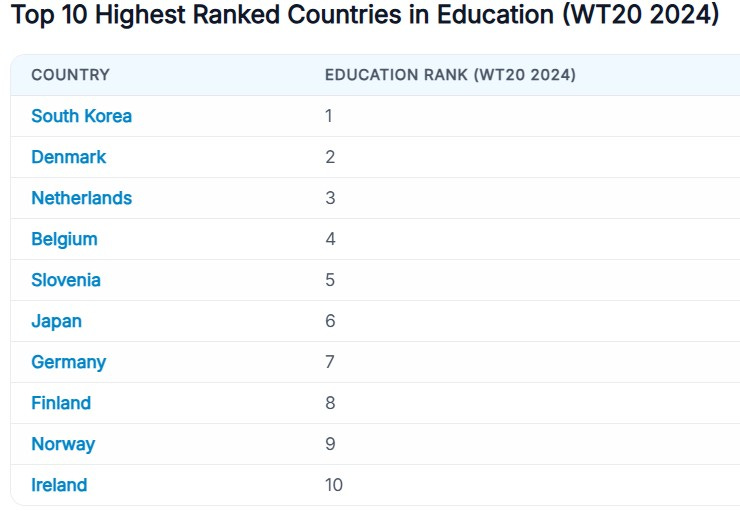
When talking about education, people always want to compare the U.S. to other countries to see how we rank up, so I wanted to include this just as an aside. Countries like South Korea, Norway, The Netherlands, and Germany have better ranked education systems than the U.S. One might ponder why this is the case and conjure up many possible reasons for this. When comparing the U.S. education system to other countries, I always keep in mind that these ranking systems may or may not consider race and socio-economic disparity. Plus, the U.S. is not a federally operated school system, that also means in some ways it is harder to make comparisons to smaller, more homogenous countries. More importantly, rich kids perform better. What we are really measuring when we test children’s academic achievement is their overall socio-economic status and perhaps the reason the U.S. ranks so low is more due to the giant economic disparities between the uber-rich and the uber-poor. Why do we need to keep measuring that over and over? What is the point? If we really want to improve education outcomes, we have to improve the living conditions for children in the most economically depressed areas. I am not talking government handouts, though. All I am saying is that increased rigor and more academic testing is not a solution for the real problem that underlies the “low performance” of an entire country’s school system.
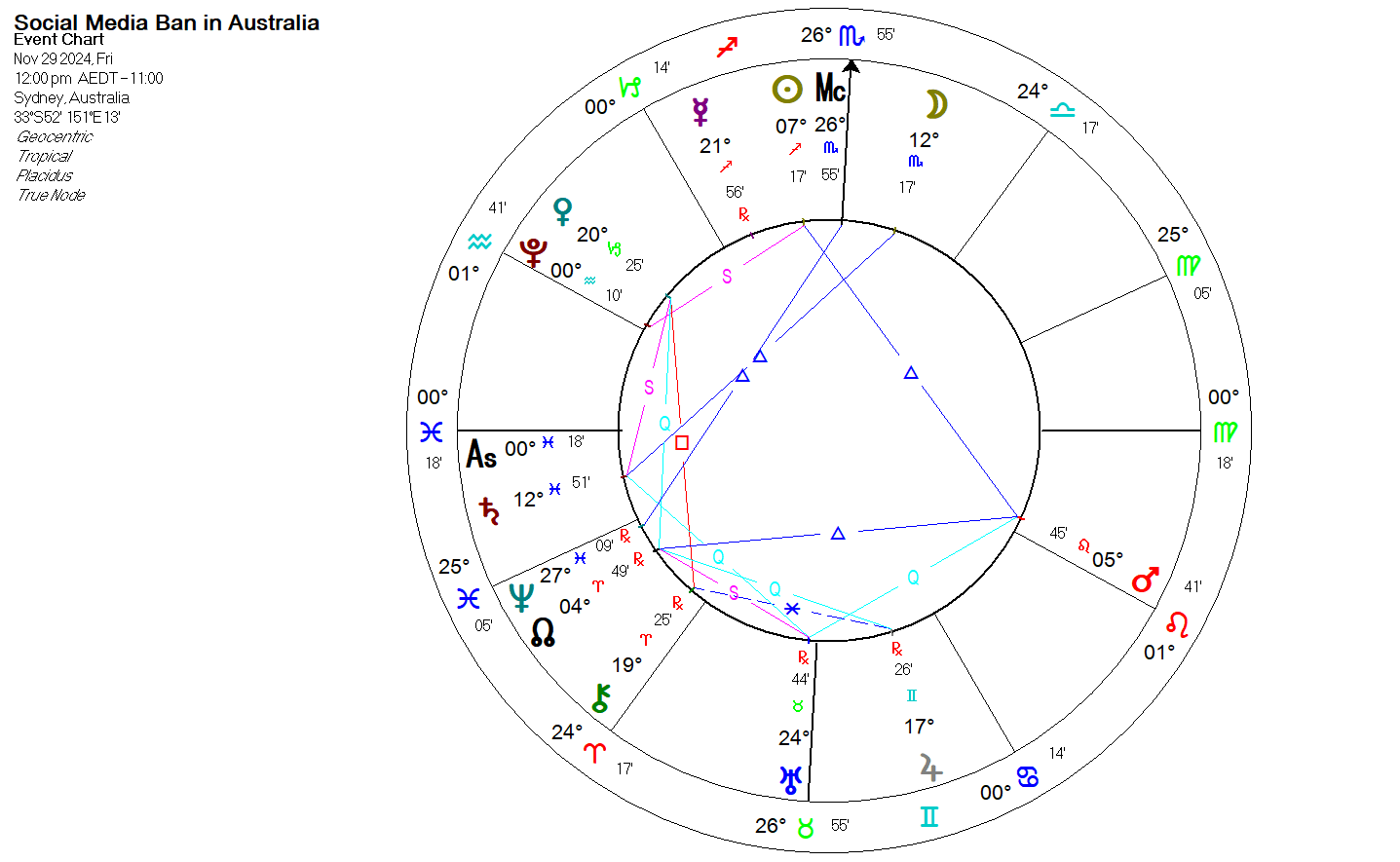
To link this to astrology, here is the chart for the Australian social media ban. I could not find a time for the actual passing of the law, so I took a noon time for Sydney. Supportive septiles and quintiles are present, only one square between Venus and Chiron. Jupiter in Gemini sextile to Chiron, Mercury and many other planets in retrograde makes me wonder if these laws will require a lot of rethinking and revision. A thorough comparison of this chart to the country chart of Australia and the charts of some of the big social media companies would be interesting.