

Educators have long known that the time period between age 12 and 15 is a very sensitive age where a young person is struggling to define their own identity. Once I began studying the cosmic blueprint of human development through astrology though, I learned that there are astrological markers tied to every age in a person’s life. Every person entering their early teens faces some of the most rapid developmental changes of their lives since the time of fetal development, and we see this in astrology in terms of rapid transits too, particularly between ages 12 to 14.
At age 11-12 Jupiter returns to the place where it was when a person was born, sort of a Jupiter birthday if you will, opening up a new phase of growth that marks the onset of puberty. By age 14-15, Saturn is halfway around the Sun from where it was when a person was born. In astrology this is the called the first Saturn opposition, and it is linked to that well-known time period when a young person tests authority. These two transits form the architecture of the often challenging, rebellious teen years, a “Shadowland” as astrologer, Alex Trenoweth calls it, through which a person must pass during those pivotal years of adolescent development.
About two years after the Jupiter birthday, Jupiter makes a sextile (60 degree) aspect to its natal position, providing extra impetus for growth, extra bravado and risk taking, as well as curiosity and desire to explore new realms of knowledge with a greater capacity for abstract thinking. The planet most associated with independence, Uranus, also makes a sextile to its own natal placement at age 14 during that same time period, providing further sparks of rebellion and independence. Because of the variance in planetary retrograde periods, it may seem like a dice roll as to whether a person experiences their Jupiter Sextile first or their Uranus Sextile.
My curiosity is this: How do these transits mirror human development? Does having a Uranus sextile first mean something as opposed to having the Jupiter sextile first during this window of development? Could the sequence possibly show a higher correlation to risk-taking or suicide? If a large enough sample group of people who had committed suicide were taken, would any other patterns emerge? How does it compare to a more random sampling of the population? Most importantly, how can we support young people making their way through these challenging developmental phases?
I am not a counselor or research analyst. I have never even taken a course on Statistics. I’m a teacher in the trenches, a parent of three young adults, and now a grandparent. Over the years I observed many different kinds of young people from many different walks of life all experiencing these exact development phases. It seems only natural to connect my study of biography and astrology to my work with young people. If astrology (or anything) can be an aid to understanding how to better support young people in the process of growing up, why wouldn’t we utilize it?
Suicide is also an issue that has touched my life personally. My first personal experience with suicide came when the best man from our wedding, Bobby Markham, committed suicide a few years after our wedding. We knew Bobby had a drug problem, but he was also a young father with a promising career and new wife. He had a bright future ahead of him. We never expected his addiction to lead him to take his own life so suddenly. A decade or so later I was working at a small private school, and a bright teacher we had hired from the UK was experiencing mental and physical illness which ultimately brought her to take her own life. Lulu Black was a creative woman in her late twenties, so vibrant and full of life. We were all very saddened by this loss, and it left all of us who had worked with her wondering if we had missed warning signals. Sadly, these were only two of the personal experiences I have had with suicide. So, it is fair to say I have a personal interest in this topic.
What the Research Shows
Brain experts explain the massive “rewiring” that occurs during the teen years and how it is only rivaled by the earliest stages of life during fetal development. So why aren’t more people paying attention to it? Some quotes:
“Adolescence is one of the most dynamic events of human growth and development, second only to infancy in terms of the rate of developmental changes that can occur within the brain.” — Maturation of the Adolescent Brain, National Library of Medicine
“Although they knew that the brain of a baby grew by over-producing synapses... they had not known that there was a second period of over-production [just before puberty].” — Inside the Teenage Brain, PBS Frontline, Dr. Jay Giedd (National Institute of Mental Health)
The “Perfect Storm” of Change
This period is described as a unique developmental “spurt” that mirrors the foundational learning seen in toddlers.
Dr. Ron Dahl (Institute for Human Development, UC Berkeley): “It’s a perfect storm of change... the adolescent learning spurt is second only to the rapid brain development of the first five years of early childhood.” — The Hechinger Report
Maricopa Open Digital Press: “Second only to infant development, adolescents experience rapid development in a short period of time... an astounding transformation in their brains.” — Adolescence – Lifespan Development
The consensus among organizations like the National Institutes of Health (NIH) and Harvard Medical School is that while the fetal period focuses on building the “hardware” (the physical structures), adolescence is the most rapid period of updating the “software” (the connections and social-emotional processing).
When students of today spend far greater number of hours in closer contact to computers, cell phones and social media, rather than in the company of real, in-person, loving human beings, healthy friendships and healthy family relationships, it is not much of a surprise the devastating outcomes for both long and short term mental and social development. This may be why we now see the worldwide rate of increase in suicides in teens and the mental health crisis as such a growing concern.
Studying Suicide Charts
A week after Christmas 2025, I began studying charts of people who had committed suicide. It was kind of a dark undertaking at what normally be a more festive occasion. In taking a preliminary look at this question, I began looking at the charts of seven famous people who I knew had committed suicide. At first I was looking at the adolescent time period between the first Jupiter Return and the Final Saturn Opposition of age 14-15 and whether the subject had Uranus Sextile or Jupiter Sextile first. Also of interest was the length of this time period because it seemed logical to me that if a young person must experience all of these software upgrades in a shorter time period it might cause more shock to the system to have to integrate those changes more more quickly.
In the months that followed I went further, looking at a total of thirty charts, of mostly famous people who had taken their own life regardless of their age at time of death. 60% of them had experienced their Uranus sextile before the Jupiter sextile. That number seemed high. While I recognize that in the general population everyone will experience a Uranus sextile and I don’t know what that number is, (it could also be 60%!) the variability of this transit makes it harder to pin down, so all of this leads to more questions.
Questions Arising
While every human being experiences a Uranus sextile during their youth around the age of 14, the variability of planetary retrogrades means the timing shifts quite a bit. When Uranus—the planet of sudden disruption, shock, and radical individuation—strikes a fragile adolescent psyche before the stabilizing, hopeful expansion of Jupiter can anchor it, does it create a unique pressure point of vulnerability? I realize I may be putting my own interpretation into it, so it seems like it could use more eyes on it. My primary point is about the compressed nature of this developmental window. If a young person is hit with these major software upgrades in rapid succession, does it shock them even more with less time to integrate them? I realize that suicide is multi-causal, multi-factorial and one of the most complicated topics to study for moral and ethical concerns. I also realize that these thirty cases of famous people who committed suicide are just a starting point.
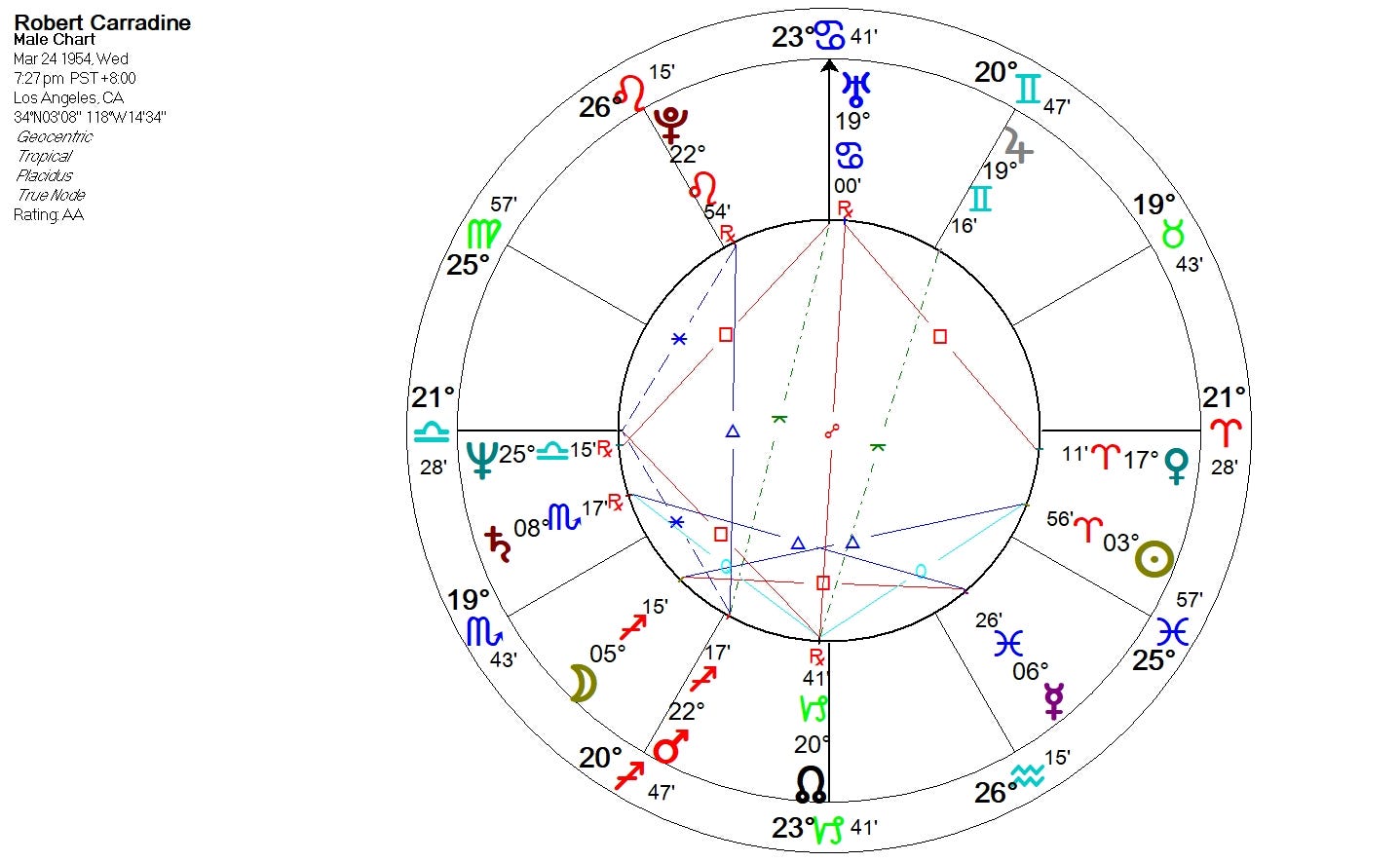
One helpful and recent case study can be found in the tragic biography of Robert Carradine, whose youthful years serves as an illustration of how this exact planetary timeline tracks alongside sudden, volatile life shifts that reverberate later on throughout a person’s life beyond the teen years. When we look at his chart and biography, it opens up deeper questions about generational patterns, questions that become even more intriguing when looking at the broader Carradine family timeline, similar to the Presley and Huston families. There is far too much to share about Carradine’s chart in this post, so I will have to save it for a future post. I’ve included Carradine’s birth chart below as a starting point for those curious to take a look.
Where This Goes Next
I am not saying, “Let’s look at all these famous people and how awful they committed suicide.” What I am saying is, “Look at this intense cosmic pressure cooker of a time period that all young people must walk through at the age of 14-years-old.” Here is why they are struggling and pushing boundaries, and here is why they desperately need our grounded, real-world support. I am not a clinical psychologist or a career statistician. I am a teacher, parent, and a grandparent. I have watched hundreds of young people navigate these crosscurrents from age 12-14. If astrology (or anything) can serve as an early warning system to help adults support struggling teens before they hit their breaking point, we would be irresponsible not to use every means at our disposal to aid them.
I am building a foundation for a more formal research project that I am hope to get published in a professional astrological journal so that other research astrologers can look into it.
Are you interested in the intersection of astrology, biography, and youth advocacy, or know others who are? Share this post!
Want to get notified of updates? Subscribe!
Laura Lee Gabelsberg | Eagle Eye Astrology
Suicide is a serious topic. If you know of anyone needing help, don’t ignore the warning signs. Get help!
Suicide Help
Need support? If you or someone you know is struggling or in crisis, help is available. You are not alone. Call or text 988 or chat at 988lifeline.org to reach the 988 Suicide & Crisis Lifeline. This service is free, confidential, and available 24/7.
For Veterans: Call 988 and press 1, or text 838255.
En Español: Llame al 988 y presione 2, o envíe un mensaje de texto con la palabra “AYUDA” al 988.
https://www.fox43.com/article/news/local/contests/girl-13-commits-suicide-after-dads-public-shaming-video-posted-online/521-5ff63e8f-6475-413d-a667-78d41625188f